
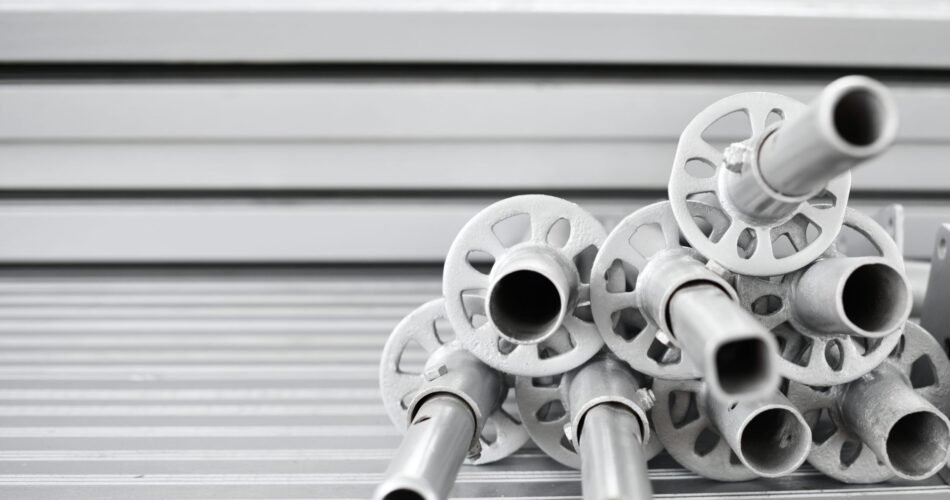
1. Greater versatility
One of the main advantages of the multidirectional system is its ability to adapt to different geometries.
It can be used around columns, facades, machinery, industrial facilities, and other structures where a conventional system may have limitations.
2. Modular Configuration
The components can be combined to create structures of various sizes.
This makes it possible to use the same system for small, medium, or large-scale projects, depending on the number of components available.
3. Adaptation to Complex Spaces
In industrial and maintenance projects, it is common to encounter pipes, equipment, metal structures, and obstacles.
The multidirectional configuration allows for the design of access solutions around these elements.
4. Greater efficiency in assembly
A properly designed modular system can simplify assembly and disassembly tasks, reducing setup time for the work area.
Efficiency will depend on factors such as design, staff experience, site conditions, and the required configuration.
5. Safety in Work at Heights
Scaffolding systems must be used in accordance with the manufacturer's specifications, project conditions, and applicable safety standards.
In addition to the structural system, it is important to consider aspects such as appropriate platforms, guardrails, access points, leveling, stability, and assembly procedures.