
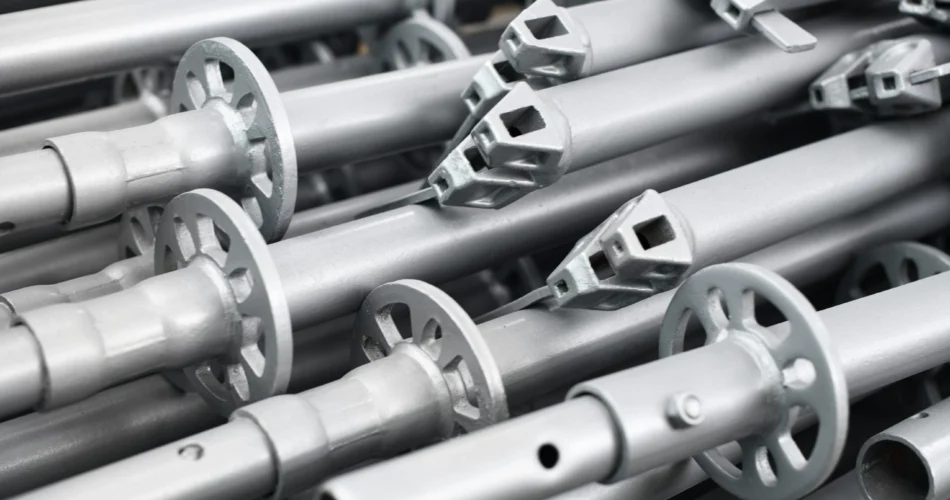
In construction projects, industrial maintenance, and work at heights, having a safe access and work system is essential. Multidirectional scaffolding has become a widely used solution due to its versatility, strength, and ability to adapt to different spaces and needs.
Unlike traditional systems, multidirectional scaffolding allows for the construction of structures with varying heights, widths, and geometries, making it easier to use in projects that require working around complex structures.
What is multidirectional scaffolding?
Multidirectional scaffolding is a modular system consisting primarily of vertical, horizontal, and diagonal members, platforms, and connecting accessories.
Its main feature is the connection system between the elements, which allows different components to be connected in multiple directions and creates stable, adaptable structures.
This flexibility allows it to be used in both conventional construction projects and industrial projects, as well as for facility maintenance, building renovation, and jobs that require special access solutions.
How does the multidirectional system work?
The system is designed to be assembled using mechanical connections that allow the structural elements to be joined at different angles.
This makes it possible to create configurations tailored to the specific characteristics of each project.
Its main components include:
- Vertical members: They form the main structure and support the loads.
- Horizontal beams: provide stability and serve as supports for platforms.
- Bracing: helps provide structural rigidity.
- Platforms: They allow you to create workspaces.
- Skirting boards: They help improve platform safety.
- Adjustable feet: allow you to level the structure.
- Stairs and access points: They make it easier to move between levels.
- Wheels: Available in certain configurations for mobile structures.
The combination of these elements makes it possible to build different types of structures depending on the project's needs.